



Listen on The Move
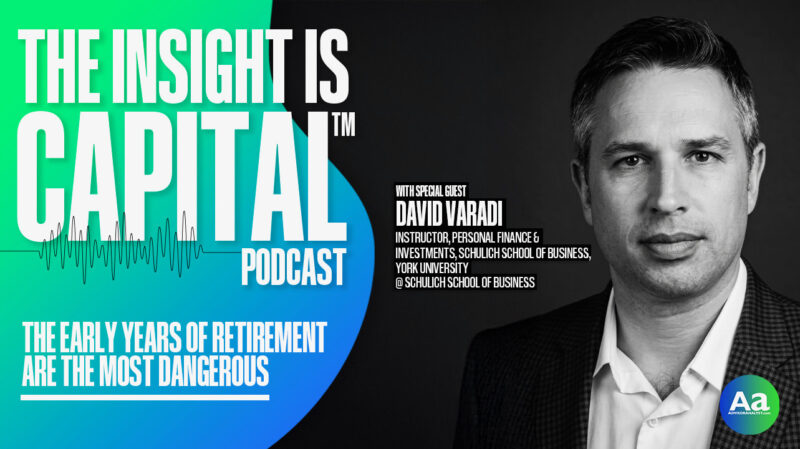
Every retiree gets exactly one shot at one sequence of returns — and the first five years can quietly cost you more than half your lifetime portfolio.
In this episode of Insight is Capital, host Pierre Daillie sits down with David Varadi, MBA, CFA, instructor of Personal Finance and Investments at the Schulich School of Business at York University, to unpack one of the most underestimated risks in retirement planning: sequence of returns risk.
Drawing on a career that spans RBC, Macquarie, Flexible Plan Investments, QuantX, and now academia, Varadi introduces the concept of the "sequence tax" — the measurable gap between what the market returns and what a retiree actually realizes after withdrawals. He explains why poor returns in the first five to ten years of retirement can permanently impair a portfolio in ways that bull markets later cannot repair, and walks through practical levers advisors can use to defend against it, including bond ladders, dynamic withdrawal cuts, trend-following overlays, and diversification beyond the traditional 60/40 mix.
The conversation moves into the four economic regimes, why long-duration treasuries, energy, utilities, and managed futures each play a distinct hedging role, and how capital efficiency — using leveraged or portable-alpha structures to free up liquidity — can help underfunded clients diversify into annuities, tontines, and real assets without taking on a purely speculative, all-equity gamble. Varadi closes with a call for advisors to calculate every client's required rate of return and shortfall risk, rather than relying on risk tolerance alone, to determine whether a retirement plan is actually safe versus merely comfortable.
Timestamped Chapters
00:00 — Introduction: the sequence tax and why order matters more than average return
02:00 — David Varadi's career arc: RBC, Macquarie, Flexible Plan, QuantX, and teaching at Schulich
06:00 — Why decumulation is the industry's biggest blind spot and top advisor anxiety
08:00 — What sequence of returns risk actually is and how the "sequence tax" is calculated
10:00 — Selling shares in a down market: cannibalizing the portfolio and the math of recovery
13:00 — The first five and ten years: 53% and 80% of lifetime sequence damage explained
14:00 — Levers for protection: liquidity buffers, cutting withdrawals, trend following, bond ladders
16:00 — The trade-offs of holding bonds early in retirement
24:00 — Replacing traditional fixed income with convexity: managed futures and the four market regimes
26:00 — Best hedges for long-duration bonds: energy, utilities, and commodities
28:00 — Real assets and inflation protection: pipelines, infrastructure, and rate-linked cash flows
30:00 — Managed futures as a "utility player" across market regimes
32:00 — Capital efficiency for underfunded clients: solving multiple risks with the same dollar
35:00 — X-raying the 60/40 portfolio: why it behaves like 90% equity risk
38:00 — The danger of mistaking the need for diversification as a need for more risk
48:00 — Building the floor: bonds, annuities, and tontines for funded versus underfunded clients
54:00 — Practical capital-efficiency examples: leveraged ETFs, covered calls, and portable alpha
1:01:00 — Calculating the retirement required rate of return and the conservative-client mismatch
1:02:00 — Shortfall risk versus standard deviation: optimizing for retirement survival
1:04:00 — Closing thoughts and a look ahead to capital efficiency in depth
sequence of returns risk, retirement income planning, decumulation strategy, sequence risk retirement, retirement withdrawal strategy, David Varadi, Schulich School of Business, capital efficiency portfolio, portable alpha, managed futures retirement, 60/40 portfolio risk, bond ladder retirement, annuities versus tontines, shortfall risk, retirement required rate of return, underfunded retirement, longevity risk, inflation hedge portfolio, retirement income advisor, financial advisor decumulation
#SequenceOfReturnsRisk #RetirementPlanning #DecumulationStrategy #RetirementIncome #FinancialAdvisor #PersonalFinance #PortfolioConstruction #CapitalEfficiency #ManagedFutures #RetirementSavings #WealthManagement #InvestingForRetirement #FinancialPlanning #InsightIsCapital #SchulichSchoolOfBusiness #RetirementRiskManagement #AssetAllocation #FixedIncomeStrategy #AnnuitiesVsTontines #FinanceEducation