


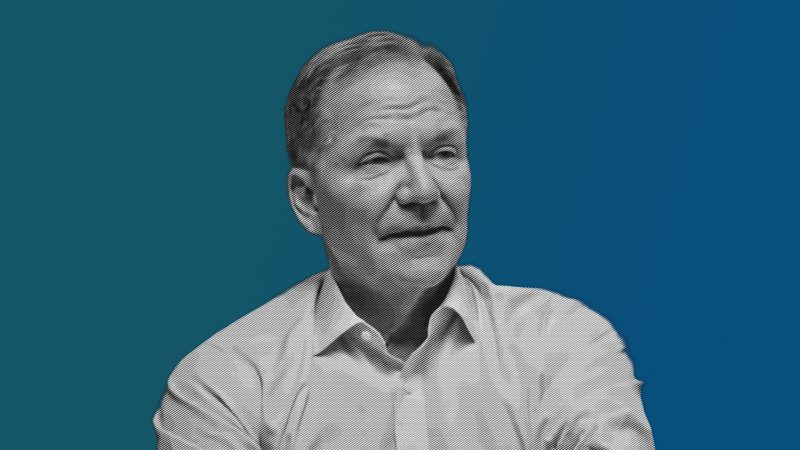

When OSAM's Patrick O'Shaughnessy, host of Invest Like The Best, sits down with legendary investor Paul Tudor Jones, the expectation is market intelligence of the highest order. What emerges instead — or rather, what runs alongside it — is something rarer: a fully formed philosophy of risk, meaning, and human resilience from one of the most consequential investors alive11. Spanning AI regulation, sovereign debt, the case for Warren Buffett, and the compounding power of a single act of kindness, the conversation is a masterclass in how the best traders think about everything at once.
The Investor vs. The Trader
Jones opens with a confession that doubles as a tribute. For decades, he dismissively critiqued Warren Buffett's buy-and-hold approach, convinced that active trading was the superior discipline. Then, at the urging of a podcast, he listened to the Acquired episode on Berkshire Hathaway.
"For the first time, I learned that at 9 years old — 9 years old — he understood the power of compound interest," Jones said. "And I have been the drugstool. I've always wanted to write a book called What I Realize Now. What I realize now is what an idiot I was. That guy is a flipping genius because he understood the power of compound interest, which I somehow managed brilliantly to avoid my entire career."
The contrast between the two disciplines is fundamental. Jones's BVI fund, running for forty years, carries a minus-0.12 correlation with the S&P 500 — 100% alpha, zero beta. It is a different game entirely. "I feel like I'm a right guard in the NFL," he says. "I've been a right guard for 50 years, where I'm just every day fighting in the fricking trenches." The investor's life — believing in America, buying on drawdowns, letting time compound — requires a psychological durability Jones says he cannot claim. "I would have huge difficulty to have been in Warren's shoes in 2008 and 9 and have a 50% drawdown. It would have had a really material impact on me." His admiration, in the end, is total. "Warren, if you happen to hear this, I'm deeply apologetic. You are the OG of compound interest."
Bubbles, Leverage, and the S&P 500 Warning
O'Shaughnessy presses Jones on whether today's markets constitute a bubble. The answer is measured but sobering. Every major crash in Jones's five-decade career shares a common ancestor: excessive leverage, frequently expressed through derivatives.
"If I think of the big ones — 1987 was 100% portfolio insurance. 1998 was long-term capital, big derivatives. 2000 was different — the easiest bear market I've ever seen in my whole life." And the current moment? "We're clearly so leveraged in equities in this country. We're so dependent upon firm equity prices at this point in time." The data he cites is striking: stock market cap as a percentage of GDP stood at roughly 65% in 1929, 85–90% in 1987, 170% in 2000, and today sits at 252%. A mean-reversion to historical PE ratios would imply a 30–35% decline — and at 250% of GDP, that reverse wealth effect "would be 89% of GDP. Ten percent of our tax revenues from capital gains go to zero. You can see the budget deficit blowing up, you can see the bond market getting smoked. You can see this kind of negative self-reinforcing effect."
His advice to a wealth manager friend who pressed him on twenty-year equity allocations is pointed: "If you buy the S&P at this current valuation, the 10-year forward returns are negative when you buy with the S&P at 22 times. That's what history shows." He is equally alert to the structural supply shift approaching equity markets. IPO volumes projected at 5–6% of market cap, combined with waning buybacks as hyperscalers redirect cash to AI capex, could produce a "rolling top" and extended underperformance in tech. "That'll just be adding equity supply and you're already going to be diminishing the buybacks."
Private markets compound the concern. "Private equity in 2007, 2008 was about 7% of institutional portfolios. Now it's about 16%." The system, in his view, is far less liquid than it appears — and the reckoning, when it comes, will be felt more broadly than investors currently anticipate.
AI: The Genie and the Tail Risk
Jones's alarm about artificial intelligence is among the most urgent sections of the conversation, and worth dwelling on. He describes attending a private conference of roughly thirty-five to forty people that included one modeller from each of the four largest AI companies. When asked pointedly how they expected AI safety to be resolved, the consensus answer disturbed him. "Pretty much the consensus answer is, I think we'll finally do something about it when 50 or 100 million people die in an accident."
The structural issue, as Jones frames it, is that the "build, break, iterate" model of innovation — civilisation's default since the beginning — has never before carried a tail event of this magnitude. "We've never been in a situation where the break you do so much damage, could be hundreds of millions, if not billions of lives." He draws the historical parallel directly: "When the nuclear bomb was dropped, eighteen months later our Congress was smart enough to create the Atomic Energy Commission. Here we are, three years in — regulate? What are you talking about? If there ever was a leadership position that needs to be taken by any president, it's on AI regulation. Right now."
His proposed first step is elegantly simple: mandatory AI watermarking, with criminal penalties for knowing violations. "I want to know what's authentically human and what's not. And when that happens, talk about restoring trust in the country." He shared that twice in the year prior, credible sources had contacted him about content that turned out to be deep fakes. The erosion of epistemic trust, in his view, is not a secondary concern — it is itself a systemic risk.
On the longer horizon, Jones engages with the "workless world" problem. He admits he once viewed a future in which AI displaces human labour with "a really negative outlook," given how much significance people derive from work. His perspective has shifted toward cautious optimism: "I think maybe humans are adaptable enough that we'll find a different way to find significance." But the question remains urgent. "That's going to be the biggest challenge potentially in four or five years — what do we do when so many of our jobs have been replaced by AI?"
Trading as Craft: Execution, Patience, and the Yen
Jones's account of his daily routine reveals a discipline built on structure and intentional attention management. Up at 6:15, an hour of analytical work, forty-five minutes of hard cardio, at the screens for the open, meetings cleared by noon, a mandatory hour before and after the close to map the following session. Midnights bring another half-hour of analysis during Tokyo hours. The enemy of good trading, as he sees it, is information overload. "I get 800 to 1,000 emails a day. If I think about when I was a pit trader, I could spend more of my time intently focusing on what the highs and lows were going to be in the day." Exquisite execution, he explains, is simply "am I buying when there's blood on the ground and am I selling when there's complete elation."
His framework for identifying major macro trades centres on three conditions: undervalued and under-owned, out-of-sync with fundamentals for too long, and waiting for a catalytic moment. He applies the framework live to the dollar-yen setup. "The yen's grossly undervalued, has been for some time. What's the catalytic moment? Japan has a $4.5 trillion net international investment position with the rest of the world, probably 60% of it in the US and most of that unhedged." The election of Japan's new prime minister, whom he compares to Reagan and Thatcher in terms of reform orientation, is the catalyst. "You're looking for something that's under-owned, undervalued, way out of whack. People have gotten complacent on it. And you're looking for that catalytic moment."
Communication as an Edge
One of the conversation's more unexpected turns concerns journalism. Jones argues that newspaper writing — not business school — is the single most useful training for any investor or trader. The discipline of leading with the conclusion, compressing the essential facts into two sentences, and hierarchicalising information from most to least important is, in his view, a form of principal component analysis. "In trading there are so many different variables. Every one of those will have its day. It'll rotate through in terms of importance. Newspaper style helps you ask: what's the most important thing that's actionable at this second in that particular instrument?" He tells O'Shaughnessy he has delivered this message to the same investments class at the University of Virginia every semester for more than forty years.
Five Key Takeaways for Advisors and Investors
Current equity valuations carry real historical risk.
At 252% of market cap to GDP — nearly four times the 1929 peak ratio — the S&P 500 is priced for outcomes that history suggests are unfavourable. Jones is explicit: buying the index at current multiples implies negative 10-year forward returns. Advisors should engage clients honestly about the relationship between entry valuation and long-term expected returns.
The illiquidity risk in institutional portfolios is underappreciated.
Private equity has grown from 7% to 16% of institutional allocations since 2008. Combined with elevated real estate and infrastructure exposures, the system is materially less liquid than it was during the last major stress event. Client portfolios with significant illiquid allocations deserve explicit scenario planning.
AI represents a systemic risk category, not merely a thematic opportunity.
Jones speaks with moral urgency about the absence of AI governance infrastructure. For advisors, this matters beyond the ethics: the absence of regulatory clarity creates tail risk across every sector with concentrated AI exposure, and the social disruption scenarios Jones describes — including mass workforce displacement — carry portfolio implications that have not yet been priced.
The lesson of Buffett applies directly to client conversations.
Jones's belated recognition of the power of compounding is not just a personal anecdote — it is an argument for the most important behavioural intervention advisors can make. The investor's edge is time, temperament, and the discipline to stay invested through drawdowns. Helping clients embody that, rather than trading in and out of fear, may be the highest-value service an advisor provides.
Communication is a competitive advantage.
Jones's advocacy for journalism-style writing — conclusion first, most important information leading — offers a direct model for client communications. In a world of information overload, the advisor who learns to lead with the essential insight and eliminate everything subordinate to it will be heard. The one who buries the point will not.
Footnote:
1 Invest Like The Best. "Legendary Trader Paul Tudor Jones on AI Risk, Bubbles and Buffett." YouTube, 28 Apr. 2026, www.youtube.com/watch?v=S31J5ACsOqU.
This editorial is produced for registered investment advisors and wealth management professionals by AdvisorAnalyst.com. It is for informational and educational purposes only and does not constitute investment advice.