





by Benjamin Wang, CFA, Portfolio Manager, Quantitative Solutions, & Zoey Zhu, CFA, Portfolio Manager, Quantitative Solutions, Janus Henderson
Over the past 15 years, international equity markets have largely taken a backseat to U.S. large caps in the eyes of many investors. However, after a breakout year for non-U.S. equities, that dynamic may be beginning to shift.
The MSCI EAFE Index, a widely followed measure of developed-market equities outside North America, gained 32% in 2025 and outperformed the S&P 500® Index by its widest margin since 1993.1 That strong relative performance has continued thus far in 2026. If the trend holds, it would mark the first consecutive years of ex-U.S. outperformance since 2007, which capped a six-year stretch in which the EAFE outperformed its U.S. counterpart.
While artificial intelligence remains a dominant force across global equities, elevated U.S. market concentration, improving earnings expectations across several developed markets, and a still-meaningful valuation discount relative to U.S. peers have encouraged some investors to look more broadly across the global equity landscape.
We believe the breadth and diversity of developed markets outside the U.S. make them particularly well suited to a disciplined multi-factor approach.
A large and diverse opportunity set
International equity markets offer investors access to hundreds of companies across different geographies, sectors, currencies, and business cycles. The opportunity set also looks markedly different from the U.S. market. While technology and communication services account for nearly half of the S&P 500, the MSCI EAFE Index has far greater representation from financials, industrials, materials, and other economically sensitive sectors.
Exhibit 1: A more diverse, less tech-heavy sector mix outside the U.S.
S&P 500 Index and MSCI EAFE Index GICS sector weightings
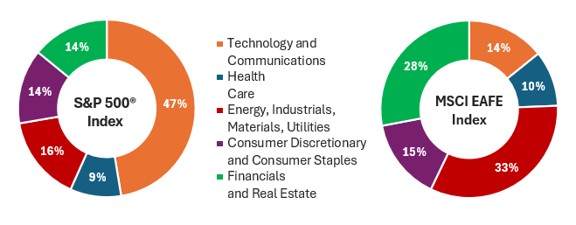
Source: S&P Global, MSCI. Data as of 31 August 2026. The MSCI EAFE Index reflects the equity market performance of developed markets, excluding the U.S. and Canada. The S&P 500 Index reflects U.S. large-cap equity performance and represents broad U.S. equity market performance.
In addition to serving as a counterbalance to tech-heavy U.S. exposure, this less homogeneous market composition provides access to a wider range of potential return drivers. In our view, the fragmented nature of international equity markets also has the potential to create inefficiencies that a multi-factor investment framework can seek to capitalize on, much as it has historically done within U.S. small- and mid-cap equities.
The value of a balanced multi-factor framework
No single factor has consistently outperformed across every market environment. Quality, valuation, capital efficiency, and business momentum can each experience extended periods of relative strength and weakness. And as market leadership shifts over time, investors who become overly reliant on any one factor may be exposed to periods of underperformance. Conversely, a multi-factor approach offers the potential to participate when certain factors come into favor, while diversification can help smooth the ride when market dynamics shift.
Business momentum provides a useful example. Broadly speaking, this factor seeks to identify companies exhibiting improving business momentum, such as upward revisions to earnings estimates, alongside positive share-price appreciation – in other words, where fundamentals and market expectations appear to be moving in the same direction. Business momentum has been a powerful driver of returns in recent years, particularly through the latter half of 2025 and again in the spring of this year. However, a sharp reversal during late June and July served as an important reminder about the potential for outsized volatility following stretches of strong outperformance.
By balancing factor exposures, characteristics such as quality and valuation, which have historically exhibited different performance patterns than business momentum, can help provide exposure to a broader set of return drivers. Moreover, that diversification benefit has the potential to contribute to returns across market regimes and over longer time horizons.
While many of the same high-level factors that have historically been effective within U.S. equities have also proven effective internationally, the signals that underpin those factors can differ meaningfully.
Factors through the lens of ex-U.S. equity markets
Value has been one of the most persistent factors across both U.S. and international markets. However, certain valuation subfactors have historically been more powerful in overseas markets. Dividend yield, for example, has been a dominant force in international developed markets. In the U.S., soaring tech valuations, a more growth-oriented sector mix (whose companies often favor reinvestment over dividend payouts), and a general preference for share repurchases have driven down dividend yields over time.
One way we can quantify the difference is by sorting stocks into quintiles based on dividend yield and comparing the returns of the highest- and lowest-ranked cohorts. When viewed through that lens, the contrast is striking. Over the past 20 years, stocks in the highest dividend-yield quintile across the MSCI EAFE universe outperformed those in the lowest quintile by 3.5% annually on average. Over that same timeframe, the performance gap between top and bottom dividend payers in the U.S. was just 0.7%.
Exhibit 2: Dividend yield has been a much stronger return driver in international markets
Total return differential between top and bottom quintiles (quarterly data, annualized)
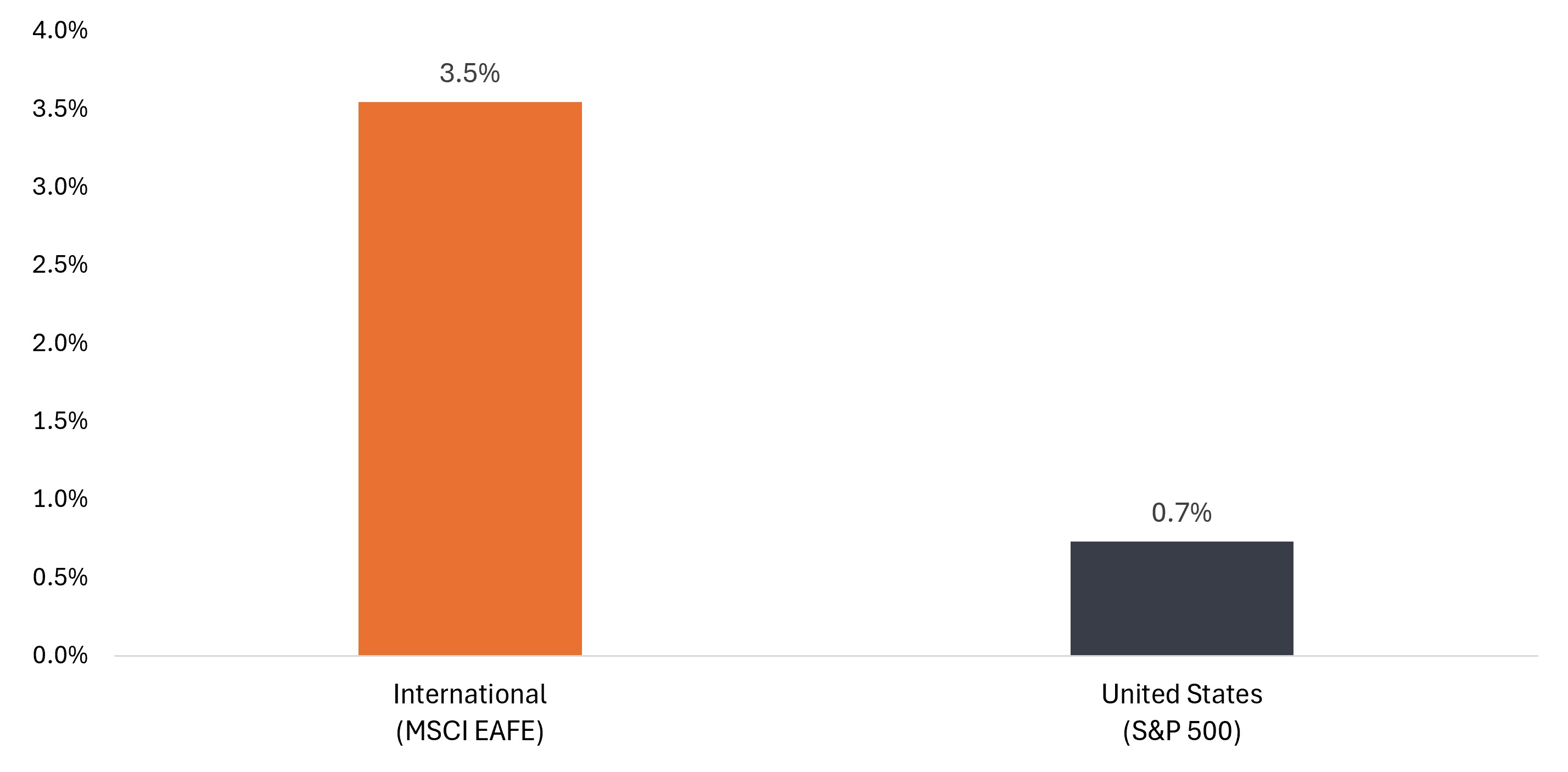
Source: FactSet data, MSCI EAFE Index universe, JHI analysis. Quarterly data, annualized, from 30 June 2006 to 30 June 2026. Figures show the total return difference between stocks ranked in the top and bottom quintiles for the dividend yield factor. Past performance is no guarantee of future results.
Similar nuances can be found across the quality factor. While profitability metrics such as return on equity (ROE) dominate the tech-heavy U.S. market, these measures can be less influential in developed markets outside the U.S., where the asset-light technology subset plays a smaller role. The heavier weighting in financials also gives more power to quality subfactors such as return-on-assets (ROA) overseas, while return-on-invested-capital (ROIC) and ROE tend to play a larger role in the U.S. market.
Still, while certain subfactors may carry greater weight in some markets than others, this doesn’t mean investors should chase individual factors that seem to be working at a given moment or attempt to time shifts in regional dynamics. Our research has shown factors to be more similar across countries than different over the long run. Rather, we believe diversification across and within factors offers a more durable approach in managing volatility and navigating evolving market dynamics.
Exhibit 3: Over a 20-year period, a diversified model that incorporates quality, valuation, and capital efficiency alongside business momentum has shown greater efficacy than any one factor alone.
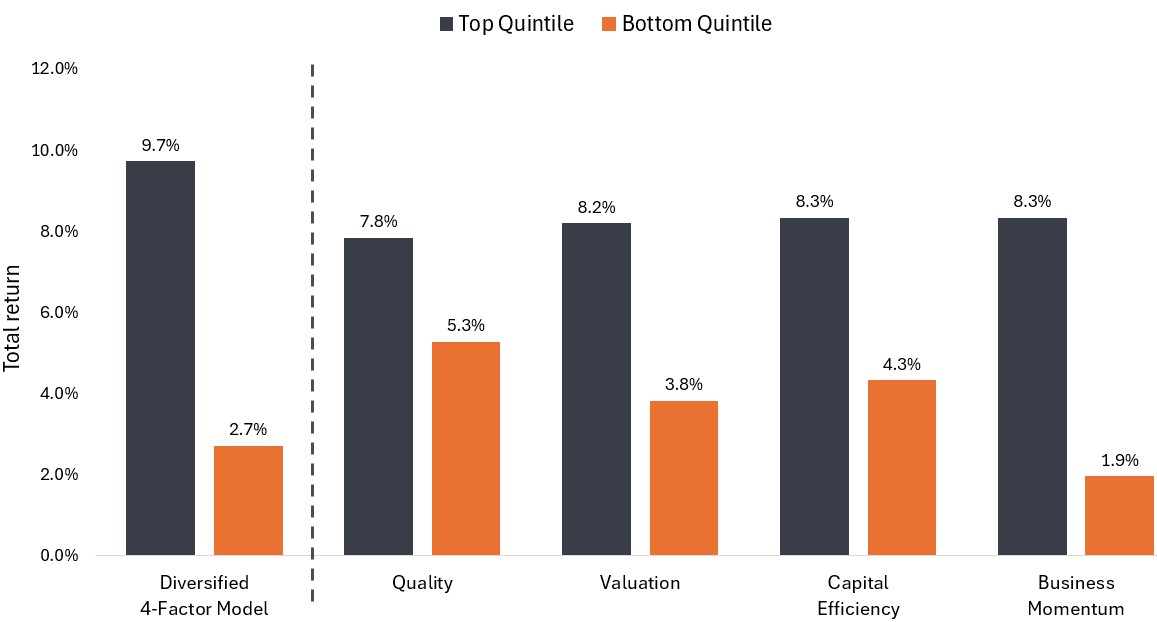
Source: FactSet data, MSCI EAFE Index universe, JHI analysis. Quarterly data, annualized, from 30 June 2006 to 30 June 2026. Past performance is no guarantee of future results.
Bottom line for investors
For investors looking beyond U.S. market leadership, international developed markets offer a large and diverse investment universe, with a broad set of return drivers less tethered to the fortunes of a handful of mega-cap technology companies. They can also provide exposure to different currencies, which may offer diversification benefits should the U.S. dollar weaken.
Yet with that opportunity comes the complexity of investing across varied geographies, business cycles, and policy backdrops. We believe investors are best served by maintaining balanced exposure across multiple factors, which may help portfolios navigate different market environments rather than relying on any single factor to drive results.
Copyright © Janus Henderson