





by Russ Koesterich, CFA, JD, Portfolio Manager, BlackRock
In this article, Russ Koesterich discusses gold’s recent positive correlation with stocks, particularly those names showing strong price momentum.
Key takeaways
- Despite a few challenging days, gold continues its upward climb, reflecting a correlation with momentum themes like early growth that have dominated the market in 2025.
- In light of this, Russ cautions that in the near-term, gold is likely to remain volatile given the momentum trade unwind but still likes the yellow metal as a portfolio diversifier.
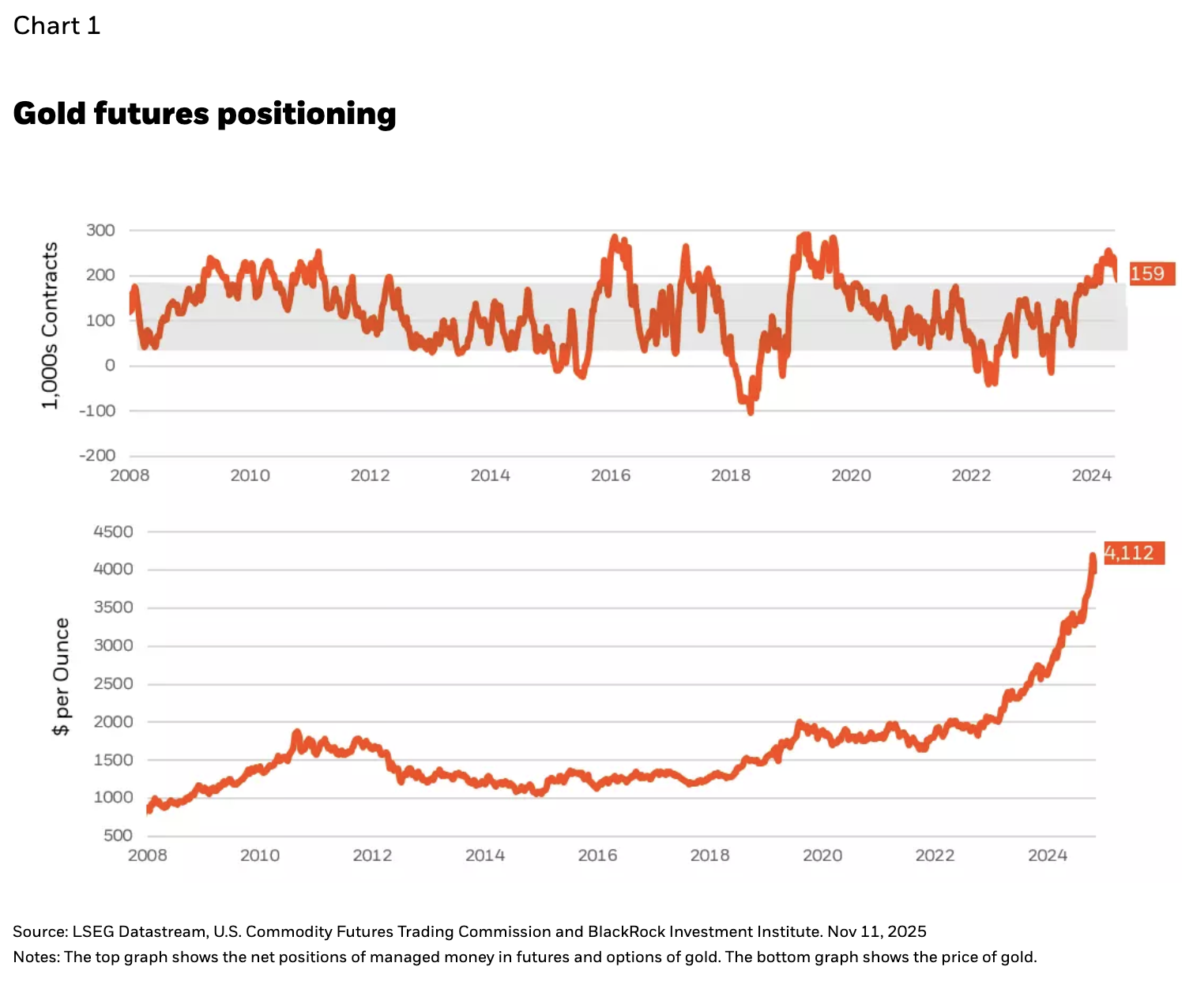
For an asset often viewed as a safe-haven, gold has had a wild ride. Starting last fall, gold advanced more than 70% in less than a year as seen on Bloomberg. That stellar run was shattered in mid-October. While there was no obvious catalyst, gold plunged -10% in a matter of days before recovering half the losses by November 12th.
I last discussed gold in late August. At the time, I highlighted the potential for upcoming seasonal volatility and gold’s history of outperforming stocks when vol spikes. While gold did indeed surge 25% from the end of August through the October peak, it was not for the reasons I cited. In fact, it was exactly the opposite of the scenario I highlighted.
Except for one bad day in early October 2025, the seasonal surge in equity volatility, as measured by the VIX, never arrived. Instead, markets rallied in September and October, with a modest pullback not arriving until early November. And gold? Rather than providing any diversification benefit, gold tended to follow equities.
While there is no fundamental reason gold should trade with the stock market, increasingly there is a technical one: gold has become another manifestation of the momentum trade, i.e. investors chasing whatever has gone up the most.
Most recently, when looking at correlation on Bloomberg year to date, gold has had a slight positive correlation with stocks as measured by the MSCI ACWI index. That correlation rises significantly when comparing gold to stocks with one specific characteristic: price momentum. In other words, gold has been swept up with early growth and other thematic trades that dominated markets through much of the fall. And as with many of these trades, gold benefited as investors indiscriminately piled into the trade (see Chart 1). But when the trade hit a wall back in October, gold sold off hard along with other momentum themes, such as early growth stocks.
Long-term thesis has not changed
What to expect going forward? We believe near-term gold is likely to remain volatile as the momentum trade continues to unwind. That said, the long-term rationale for holding gold has not changed.
While gold has proved an unreliable equity hedge it is still a useful offset to a weakening dollar. During the past five years, gold’s correlation with the Dollar Index (DXY) has been consistently negative, at around -0.60 as seen on Bloomberg. To the extent dollar weakness remains a long-term risk, gold is a useful portfolio tool.
Related to the dollar are the concerns surrounding the U.S. fiscal picture, concerns that have not exactly been alleviated during the government shutdown. In the long-term, gold still tracks with government debt, which is still rising at a pace never seen outside of war or recession.1
Gold appears to have temporarily morphed into a momentum trade. While this is likely to create more short-term volatility, I would use weakness to modestly add to positions. Long term, nothing has changed as to why you hold gold in the first place.