




by Sammy Suzuki, AllianceBernstein
In this new era of emerging-market (EM) investing, some of the brightest opportunities can be found among market followers rather than market leaders—that is, companies that are often dismissed by developed-world investors as mere “copycats.”
Particularly given today’s tough EM environment, investors should always be on the lookout for nascent growth stories. Even if a company isn’t immediately investable, this groundwork will often pay off in valuable local insights.
Finding Growth in Imitation
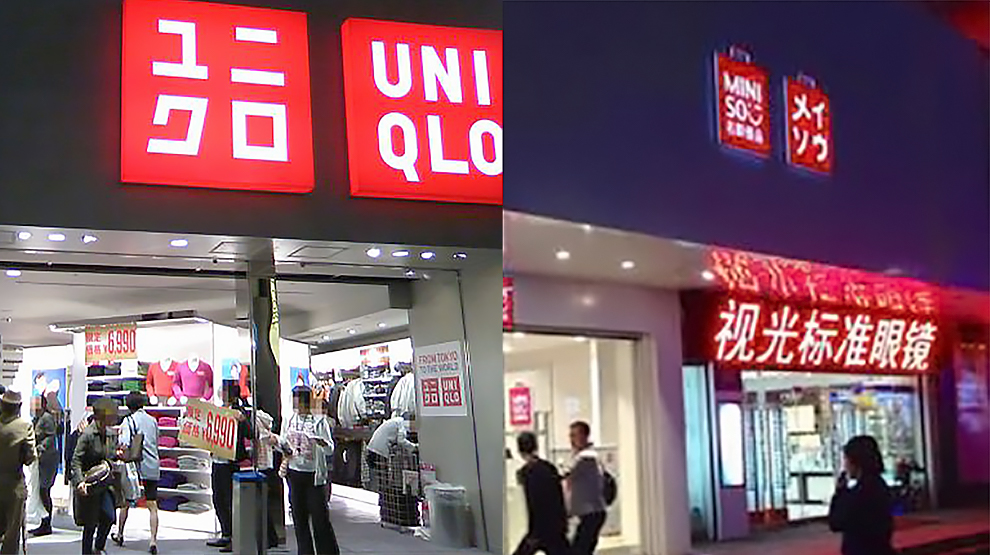
Copycat businesses are good hunting grounds for budding growth trends. Take, for example, fast-fashion chain Miniso, a Chinese knock-off of the Japanese retail brands Uniqlo, Muji and Daiso. Launched in 2013 by the Guangzhou-based company Aiyaya, Miniso initially claimed to be a famous Japanese brand, yet its Tokyo headquarters was apparently nonexistent and nobody in Japan had heard of its Japanese founder.
Miniso’s store logo resembles Uniqlo’s; its company name combines the Chinese characters for Muji, Uniqlo and Daiso; its store layout and product lineup are similar to Muji’s; and its price points are in line with 100-yen store Daiso. To top it off, the labels on many of its products are in garbled Japanese, as if they were hastily created using Baidu Translate.

Despite the confusion this engendered (not least among Japanese consumers), the chain was an immediate hit. The company now claims an estimated 1,500 stores, and has moved into locations throughout Southeast Asia and Macau. That’s impressive growth in just three years.
Miniso’s financial information is limited because it’s a privately held company. But we’ve been told that it continues to grow rapidly and is aiming for a fourfold expansion by 2020. In other words, what started out as an awkward mix of three Japanese concepts seems to be forging its own identity, and—most important—has been given the thumbs-up by consumers, mainly for filling a price-point niche left unaddressed by the Japanese formats it was imitating.
More Copycats on the Prowl
There are many other examples of successful copycat brands in emerging markets. Lojas Renner, Brazil’s largest clothing chain, is transforming itself by emulating the fast-fashion model of Spain’s international Zara chain, known for its local production, precision logistics and speedy runway-to-store turnaround time. This Zara wannabe is not only outperforming its Brazilian rivals, but is also doing better than Zara locally.
South Korea’s The Face Shop, reminiscent of British cosmetics and skin care retailer The Body Shop, operates more than 2,300 stores in 29 countries and is now part of the publicly listed company LG Household & Health Care.
Then there’s Anta Sports Products. This Chinese footwear maker has quickly gained traction, with sales growth in the mid-teens over the past three years, to become the third-largest sneaker brand in China, behind global giants Nike and Adidas. Anta’s price points and quality are lower than Nike’s, so the two don’t compete directly. But Anta’s logo looks a lot like Nike’s famous swoosh, only flipped upside down, and its stores are modeled after Nike’s too.
Not All Winners Are Pioneers
We’re not touting counterfeits; far from it. We’re talking about well executed, lawful imitations that don’t infringe on copyrights and other intellectual property. It’s also worth remembering that many of today’s industry behemoths started out as lowly copycats.
In the developing world, fortunes are commonly made by copying certain elements of a successful global business model and adapting—and improving upon—them for local markets. That is famously true of both Japanese and South Korean consumer electronics companies. And is Miniso’s origin story so different from that of Häagen-Dazs, the Danish-sounding ice cream brand invented by Polish immigrants living in the Bronx, New York? The original cartons even bore a map of Denmark.
So our advice would be: Don’t dismiss knock-offs. They could be giants in the making.
The views expressed herein do not constitute research, investment advice or trade recommendations and do not necessarily represent the views of all AB portfolio-management teams.
Copyright © AllianceBernstein