The Four Piston Portfolio: Why diversification needs an engine, not just a label

What if the reason your portfolio sometimes fails you isn’t the assets you picked — but the engine you never built?

In this episode of Insight Is Capital, host Pierre Daillie sits down with Rodrigo Gordillo, President and Portfolio Manager at ReSolve Asset Management, for a masterclass in what truly diversified, all-weather portfolio construction actually looks like — and why it’s fundamentally different from anything most advisors and investors have ever been offered.

Rodrigo’s story begins in Lima, Peru — where a government printing money into hyperinflation wiped out his family’s savings overnight — and runs through the dot-com crash, the 2008 financial crisis, and the brutal 2022 simultaneous collapse of stocks and bonds. Those lived experiences didn’t just shape his worldview; they became the architecture of a completely different way to build portfolios.

What emerges from this conversation is a framework that challenges nearly every assumption embedded in the standard 60/40 model — and explains why most “diversified” portfolios are actually running 85–90% equity risk under the hood. Rodrigo and Pierre explore how thoughtful, purposeful leverage can transform a low-octane diversified portfolio into something that competes with equities — without simply concentrating more risk in equities.

From regime-aware asset allocation across equities, bonds, gold, and systematic macro strategies, to the mechanics of return stacking and portable alpha, to the emerging institutional concept of “total portfolio” risk budgeting — this episode covers the intellectual terrain that separates sophisticated portfolio construction from the conventional wisdom most advisors were trained on.

Whether you’re a seasoned allocator or just beginning to question the limits of traditional asset allocation, this is a conversation about what it truly means to prepare for an unknowable future — not predict it.

⏱ CHAPTERS

00:00 — Introduction: All-Terrain Investing & What It Takes to Build for Any Market Weathern01:25 — Rodrigo’s Origin Story: Hyperinflation in Peru, Immigration to Canada & Early Financial Scarsn05:14 — From Commerce & Statistics to Quant Finance: Why “Don’t Lose Money” Became His North Starn07:01 — What Is the All Terrain Fund? The Problem It’s Designed to Solven10:22 — Equity-Like Returns With a Different Risk Profile: The Core Promisen13:04 — Prepare, Don’t Predict: The Philosophy Behind Regime-Aware Portfolio Designn17:18 — The Four Pistons: Global Equities, Bonds, Gold & Systematic Macro — and Why Each Mattersn20:16 — Inflation Regimes, Growth Regimes, and What Actually Works Whenn22:17 — The 60/40 Illusion: Why “Balanced” Portfolios Are Actually 85–90% Equity Riskn36:40 — The Nobel Prize–Winning Case for Defensive Leverage: What It Is and Isn’tn38:30 — Risk Management Filters: Momentum, Trend, and Knowing When to Step Asiden41:32 — Adding the Fifth Piston: Systematic Macro, Managed Futures & Crisis Alphan42:55 — Return Stacking & Portable Alpha: How to Add Diversifiers Without Selling Your Coren51:03 — Tail Protection and Long Volatility: The Final Layer of the Frameworkn01:03:09 — Backtests, Forward Expectations & The Simple Math Behind Stacking Risk Premian01:08:52 — Rethinking the 100% Portfolio: How Institutions Actually Think About Risk Budgetsn01:11:04 — The Total Portfolio Approach: A Brand New Institutional Concept That’s 20 Years Oldn01:14:02 — Wrap-Up, Where to Learn More & Resources

🔗 RESOURCES & LINKS

ReSolve Asset Management — All Terrain Strategy: investresolve.com/strategiesnnReturn Stacked ETFs & Portfolio Explorer: returnstacked.com

#AllTerrainInvesting #ReturnStacking #RiskParity #PortfolioConstruction #ManagedFutures #SystematicMacro #AdaptiveAssetAllocation #LiquidAlternatives #PortableAlpha #WealthManagement #FinancialAdvisors #AdvisorEducation #AllWeatherPortfolio #ReSolveAssetManagement #InsightIsCapital #InvestmentStrategy #CapitalEfficiency #TrendFollowing #CrisisAlpha #MacroInvesting #Diversification #RiskBudgeting #GlobalMacro #ETFInvesting #AlternativeInvestments

The Party Always Ends: How to Build a Portfolio for the Morning After | Meb Faber

The party always ends — and Meb Faber, one of the most data-driven voices in global investing, says the evidence is now undeniable that the decade-long US equity dominance is giving way to something very different.

SUMMARY

On this episode of Raise Your Average, hosts Pierre Daillie and Mike Philbrick sit down with Meb Faber — co-founder and CIO of Cambria Investment Management, prolific researcher, and host of The Meb Faber Show — for a wide-ranging conversation about what investors and financial advisors must rethink as the rules of the game quietly change beneath their feet.

With US equity concentration at historic extremes, inflation proving stickier than expected, and geopolitical disorder accelerating structural shifts already underway, Meb makes the case that the era of a US-heavy 60/40 portfolio solving everything is in the rearview mirror. He challenges the deeply ingrained recency bias that has left most North American investors dangerously underweight in international equities and real assets — and explains what the data actually says about where opportunity is emerging.

The conversation moves from big-picture regime change into highly practical territory: how to build a portfolio that survives behaviorally, not just mathematically; how to think about concentrated, low-basis positions and the tax traps hiding inside the gains of the last 15 years; and why “tax alpha” may be the most overlooked and underutilized edge in wealth management today. Meb also shares how he’s deploying AI in his own practice — including a custom-trained GPT built on his entire body of work — and what advisors should be borrowing from that playbook right now.

⏱️ CHAPTERS

00:00 — Welcome & banter: tacos, spicy food, and market chaosnn08:00 — Meb joins; framing the moment: Venezuela to tariffs to Irannn13:00 — A regime change? Dissecting the end of the 40-year bull runnn15:00 — The bull market in diversification: foreign markets doing 30%+ while the S&P stallsnn17:00 — What advisors are underweight: ex-US equities and real assetsnn20:00 — How to explain a generational shift to clients without jargonnn24:00 — Global diversification: the evidence from 15 famous portfoliosnn27:00 — The 20% annual spread problem and why tracking error breaks investorsnn30:00 — Portfolio vulnerabilities in the cap-weighted US-dominant modelnn31:00 — Opportunities: global value, small cap, fixed income niches, real assetsnn35:00 — The “fat” portfolio: three ingredients every investor needsnn40:00 — Utilities, dividends, and the tortoise-vs-hare reversalnn44:00 — Behavioral investing: why systematic strategies existnn48:00 — The concentrated position trap: identity, emotion, and the sell decisionnn51:00 — Systematic rebalancing: lessons from Cambria’s early daysnn53:00 — “The easy money’s been made” — market phrases Meb despisesnn55:00 — Deep value and what it takes to be a missionary, not a mercenarynn58:00 — The best active managers and why they always close the door at the topnn1:00:00 — When the penthouse becomes the outhousenn1:04:00 — The Groucho Marx rule: would you buy what you already own?nn1:10:00 — Drawdown, pain tolerance, and the real test of a portfolionn1:17:00 — Concentrated low-basis positions: the tax trap hiding in plain sightnn1:19:00 — 100 years of stock data: what the best-performing stocks actually returnednn1:22:00 — Tax strategies: 351 exchanges, direct indexing, QSBS, and box spreadsnn1:27:00 — AI in practice: Meb’s custom ChatGPT and how advisors should use AI nownn1:30:00 — Behavioral AI: what happens when the bot knows you better than you donn1:32:00 — Closing thoughts: raising your average in a noisier, more complex world</p>n

#MebFaber #CambriaInvestments #GlobalDiversification #PortfolioConstruction #ValueInvesting #TrendFollowing #6040Portfolio #TaxAlpha #ConcentratedPositions #DirectIndexing #RealAssets #InternationalStocks #RegimeChange #FinancialAdvisor #WealthManagement #InvestingStrategy #RaiseYourAverage #AIInvesting #BehavioralFinance #LongTermInvesting #ETFinvesting #SmartBeta #FactorInvesting #MarketOutlook2026 #AdvisorAnalyst

How CRM3 Turns Transparency into Your Biggest Competitive Advantage

What if CRM3 turns out to be the most powerful growth tool you’ve ever been handed?

In this episode of Insight Is Capital, host Pierre Daillie sits down with Mario Cianfarani, Head of Distribution at Vanguard Canada, to explore the sweeping implications of CRM3 — Canada’s incoming total cost reporting regulation — and why the advisors who embrace it now stand to gain the most.

Mario unpacks how Vanguard’s landmark Advisors Alpha framework, now celebrating its 25th anniversary, aligns with this new era of transparency, and why the real value of advice has never lived in product selection.

Together, Pierre and Mario examine the critical mindset shifts advisors must make, the power of fee budgeting, and how top practices are already having the conversations that will define the next generation of client relationships — before they’re required to.

Chapters

0:00 — Introduction: Canada’s wealth management inflection point & CRM3 overview

1:23 — Mario’s passion for Vanguard’s investor-first mission and 15 years disrupting Canada

3:03 — The biggest mindset shifts advisors need to embrace with CRM3

4:31 — From product-centric to advice-centric: building a repeatable value narrative

6:44 — Advisors Alpha at 25: quantifying the real value of advice beyond the portfolio

8:00 — Behavioral coaching, market volatility, and keeping clients fully invested

9:52 — Transparency, trust, and ending the “black box” era of investing

11:34 — How transparency correlates with higher client satisfaction and deeper relationships

13:00 — Fee budgeting: the strategic framework for cost-conscious portfolio construction

14:40 — Vanguard’s portfolio construction philosophy: core, satellite, active & passive

19:10 — CRM3 as a competitive differentiator — and why staying flat-footed isn’t an option

21:11 — The bottom line: the win-win case for advisors and clients

23:53 — What top advisors are doing right now to get ahead of the change

27:05 — Tax alpha, rebalancing alpha, behavioral alpha — quantifying every dimension of value

27:55 — Mario’s top three action items for advisors navigating this transition

30:17 — Parting thoughts: reframing CRM3 as a practice growth opportunity

31:07 — Resources available through Vanguard Canada for advisors and dealerships

#CRM3 #TotalCostReporting #AdvisorsAlpha #VanguardCanada #WealthManagement #FinancialAdvisor #FeeTransparency #CanadianInvesting #BehavioralFinance #FinancialPlanning #InvestmentAdvice #ETFCanada #ClientExperience #FeeBudgeting #InsightIsCapital #FinTechCanada #AdvisorGrowth #PassiveInvesting #FinancialRegulation #WealthManagementCanada

Alfonso Peccatiello: You're not diversified. You just think you are.

The bond market — not equities — is the most fragile and most misunderstood foundation of your entire portfolio, and most investors have no idea what’s coming.

Episode Summary

Pierre Daillie and Mike Philbrick sit down with Alfonso Peccatiello — former ING bond portfolio manager of $20 billion and founder of macro hedge fund Palinuro Capital — for a masterclass in navigating a world where the old rules no longer apply.

With decades of disinflation now behind us, Alfonso makes the case that the classic 60/40 portfolio is structurally ill-equipped for today’s macro regime. Drawing from his own eight-quadrant savings portfolio model, he walks through how investors should think about building resilient, all-weather portfolios using risk parity principles, leverage as a diversification tool, and a mix of equities, bonds, gold, CTAs, and the U.S. dollar.

The conversation shifts to the current geopolitical shock — a potential disruption in global oil supply through the Strait of Hormuz — and why taking directional risk in a nonlinear, unpredictable event is closer to gambling than investing. Alfonso closes with a bold macro outlook: the most underappreciated story of the next year may not be the U.S. at all, but the rest of the world.

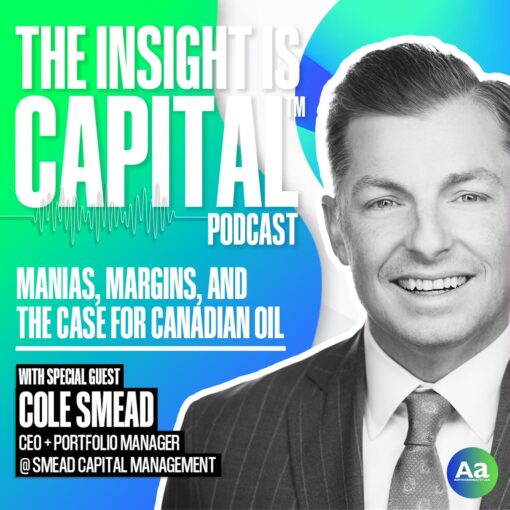
Cole Smead: Manias, Margins, and the Case for Canadian Oil

Is U.S. market dominance about to break? In this episode of Insight is Capital, Pierre Daillie sits down with Cole Smead (CEO & Portfolio Manager, Smead Capital Management) to unpack why today’s market may be less about valuations—and more about a powerful capital cycle that could reshape global investing.

From AI-driven CapEx booms to the hidden risks of passive investing, Smead draws on historical parallels—from railroads to telecom to fracking—to explain why investors often miss the biggest regime shifts… and why the next decade of returns may look very different from the last.

This conversation explores the case for international equities, the structural setup for commodities, and why Canadian oil could play a critical role in portfolios as capital flows begin to rebalance globally.

If you think diversification still means owning the S&P 500… this episode may change your perspective.

Rotation, Int'l Stocks, Defense-Tech, Japan, USD and the Gold Gap with Jeremy Schwartz and Jeff Weniger

While everyone is arguing about AI disrupting software stocks, WisdomTree’s Jeremy Schwartz and Jeff Weniger quietly explain why the most important market story of 2026 has nothing to do with the SaaS selloff — and everything to do with where capital is actually moving.

WisdomTree Global CIO Jeremy Schwartz and Head of Equity Strategy Jeff Weniger join Pierre Daillie and Mike Philbrick on Raise Your Average to cut through the noise of the AI disruption panic and make the case for a broader, more structural story unfolding in global markets. From the defense tech supercycle reshaping international equity allocations, to the gold gap most North American portfolios haven’t fixed, to a contrarian call on the US dollar at a moment of record-extreme bearish positioning — this conversation covers the ideas that matter most for advisors and investors navigating 2026. Japan, small caps, monetary policy lag, and the behavioral biases keeping investors anchored to a 15-year-old playbook all come into the discussion. If you manage money for clients — or your own — this episode is essential listening.

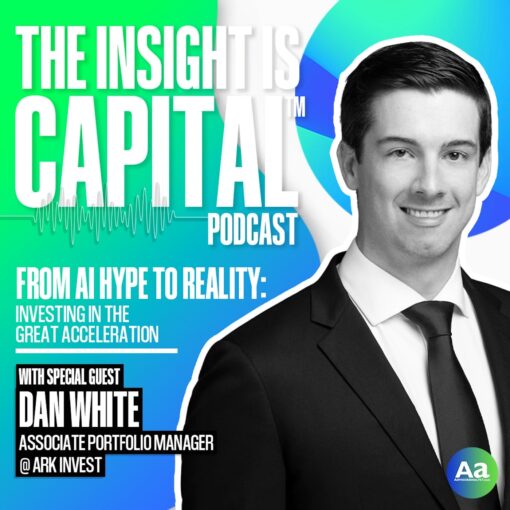
Dan White-From AI Hype to Reality—Investing in the Great Acceleration

What if the greatest risk in your portfolio right now isn’t owning too much AI — it’s catastrophically underestimating what’s actually happening?

Most investors are asking the wrong question.

The debate dominating markets right now — AI bubble or generational opportunity? — sounds sophisticated. But Pierre Daillie’s conversation with Dan White, Associate Portfolio Manager at ARK Invest, suggests the real question is far more unsettling: what if the investors playing defence are the ones taking on the most risk?

White works directly alongside Cathie Wood, sitting horizontally across ARK’s research teams to translate disruptive innovation research into portfolio strategy. He’s watched the current AI moment unfold from the inside — across public markets, private venture, and the day-to-day behaviour of a research team that is itself being transformed by the very technologies they cover.

In this episode, they go deep on the comparisons to 1999, the so-called SaaS Apocalypse, the $600 billion CapEx question, and the thesis ARK calls the Great Acceleration. What they uncover challenges just about every instinct the cautious investor has right now — about valuation, about risk, and about which side of this moment history will judge as the costly mistake.

The data White brings to the table is striking. The framework ARK uses to identify true investment platforms is specific and testable. And the thesis risks he’s willing to name out loud — including the scenarios that would genuinely break the bull case — are more concrete than most bears expect.

If you’ve been sitting on the sidelines waiting for clarity, this conversation may reframe what clarity actually looks like.

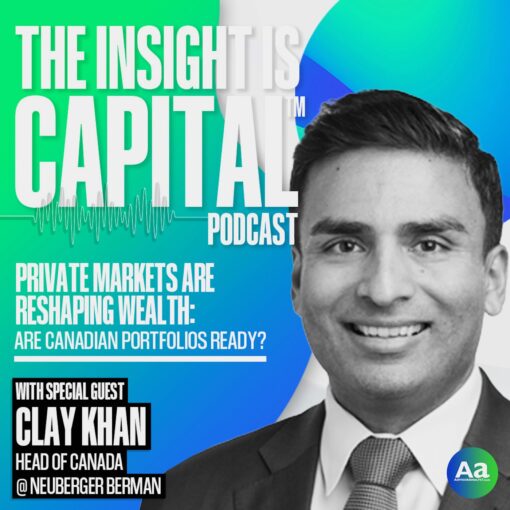
Private Markets Are Reshaping Wealth-Are Canadian Portfolios Ready with Clay Khan

If institutional investors have already shifted toward global diversification and private markets, why are most retail portfolios still stuck in the past?

In this episode of Insight Is Capital, host Pierre Daillie sits down with Clay Khan, Head of Canada and Managing Director at Neuberger Berman, to explore one of the biggest structural changes in modern portfolio construction: the migration of capital from public markets toward private assets and globally diversified strategies.

Drawing from Neuberger Berman’s “Solving for 2026” investment outlook, Khan explains how global macro forces—AI-driven productivity shifts, diverging fiscal and monetary policies, and evolving capital markets—are reshaping the investment landscape for both institutions and private investors.

The conversation dives into the growing dominance of private equity and private credit, why institutional portfolios increasingly resemble pension-style allocations, and why Canadian investors may need to rethink traditional 60/40 portfolio structures.

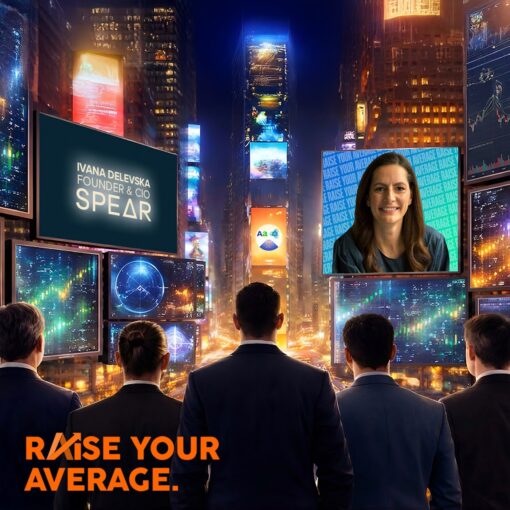
AI is Splitting the Market – The Hidden Winners Beyond NVIDIA with Ivana Delevska

AI isn’t just about Nvidia anymore — it’s quietly rewiring the entire industrial economy, and most investors don’t even realize where the real money will be made.

In this episode of Raise Your Average, hosts Pierre Daillie and Mike Philbrick sit down with Ivana Delevska, Founder and CIO of Spear Advisors, to unpack how AI is splitting the market — creating massive dispersion between winners and losers — and why passive index exposure may no longer be enough.

While most investors believe they’re diversified through Nasdaq or S&P 500 index funds, Delevska explains that passive exposure is heavily concentrated in mega-cap hyperscalers. The real opportunity, she argues, lies deeper in the AI value chain — in networking, optical components, semiconductor capital equipment, electrification, cybersecurity infrastructure, and even space.

Dennis Mitchell When Diversification Matters – The Case for Global Real Estate

When equity markets grow concentrated and expensive, the real risk isn’t volatility — it’s failing to diversify before the cycle turns.For years, global real estate has sat in what Pierre Daillie calls “the penalty box” — weighed down by rising rates, skepticism, and falling valuations. Yet beneath the headlines, fundamentals never broke.In this episode of Insight Is Capital, Pierre sits down with Dennis Mitchell, CEO and CIO of Starlight Capital, to unpack why global real estate may be one of the most misunderstood — and potentially asymmetric — opportunities in today’s market.