Alfonso Peccatiello: You're not diversified. You just think you are.

The bond market — not equities — is the most fragile and most misunderstood foundation of your entire portfolio, and most investors have no idea what’s coming.

Episode Summary

Pierre Daillie and Mike Philbrick sit down with Alfonso Peccatiello — former ING bond portfolio manager of $20 billion and founder of macro hedge fund Palinuro Capital — for a masterclass in navigating a world where the old rules no longer apply.

With decades of disinflation now behind us, Alfonso makes the case that the classic 60/40 portfolio is structurally ill-equipped for today’s macro regime. Drawing from his own eight-quadrant savings portfolio model, he walks through how investors should think about building resilient, all-weather portfolios using risk parity principles, leverage as a diversification tool, and a mix of equities, bonds, gold, CTAs, and the U.S. dollar.

The conversation shifts to the current geopolitical shock — a potential disruption in global oil supply through the Strait of Hormuz — and why taking directional risk in a nonlinear, unpredictable event is closer to gambling than investing. Alfonso closes with a bold macro outlook: the most underappreciated story of the next year may not be the U.S. at all, but the rest of the world.


Cole Smead: Manias, Margins, and the Case for Canadian Oil

Is U.S. market dominance about to break? In this episode of Insight is Capital, Pierre Daillie sits down with Cole Smead (CEO & Portfolio Manager, Smead Capital Management) to unpack why today’s market may be less about valuations—and more about a powerful capital cycle that could reshape global investing.

From AI-driven CapEx booms to the hidden risks of passive investing, Smead draws on historical parallels—from railroads to telecom to fracking—to explain why investors often miss the biggest regime shifts… and why the next decade of returns may look very different from the last.

This conversation explores the case for international equities, the structural setup for commodities, and why Canadian oil could play a critical role in portfolios as capital flows begin to rebalance globally.

If you think diversification still means owning the S&P 500… this episode may change your perspective.

Rotation, Int'l Stocks, Defense-Tech, Japan, USD and the Gold Gap with Jeremy Schwartz and Jeff Weniger

While everyone is arguing about AI disrupting software stocks, WisdomTree’s Jeremy Schwartz and Jeff Weniger quietly explain why the most important market story of 2026 has nothing to do with the SaaS selloff — and everything to do with where capital is actually moving.

WisdomTree Global CIO Jeremy Schwartz and Head of Equity Strategy Jeff Weniger join Pierre Daillie and Mike Philbrick on Raise Your Average to cut through the noise of the AI disruption panic and make the case for a broader, more structural story unfolding in global markets. From the defense tech supercycle reshaping international equity allocations, to the gold gap most North American portfolios haven’t fixed, to a contrarian call on the US dollar at a moment of record-extreme bearish positioning — this conversation covers the ideas that matter most for advisors and investors navigating 2026. Japan, small caps, monetary policy lag, and the behavioral biases keeping investors anchored to a 15-year-old playbook all come into the discussion. If you manage money for clients — or your own — this episode is essential listening.

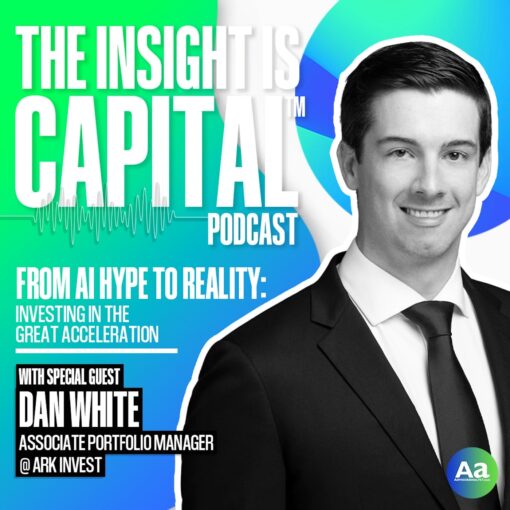
Dan White-From AI Hype to Reality—Investing in the Great Acceleration

What if the greatest risk in your portfolio right now isn’t owning too much AI — it’s catastrophically underestimating what’s actually happening?

Most investors are asking the wrong question.

The debate dominating markets right now — AI bubble or generational opportunity? — sounds sophisticated. But Pierre Daillie’s conversation with Dan White, Associate Portfolio Manager at ARK Invest, suggests the real question is far more unsettling: what if the investors playing defence are the ones taking on the most risk?

White works directly alongside Cathie Wood, sitting horizontally across ARK’s research teams to translate disruptive innovation research into portfolio strategy. He’s watched the current AI moment unfold from the inside — across public markets, private venture, and the day-to-day behaviour of a research team that is itself being transformed by the very technologies they cover.

In this episode, they go deep on the comparisons to 1999, the so-called SaaS Apocalypse, the $600 billion CapEx question, and the thesis ARK calls the Great Acceleration. What they uncover challenges just about every instinct the cautious investor has right now — about valuation, about risk, and about which side of this moment history will judge as the costly mistake.

The data White brings to the table is striking. The framework ARK uses to identify true investment platforms is specific and testable. And the thesis risks he’s willing to name out loud — including the scenarios that would genuinely break the bull case — are more concrete than most bears expect.

If you’ve been sitting on the sidelines waiting for clarity, this conversation may reframe what clarity actually looks like.

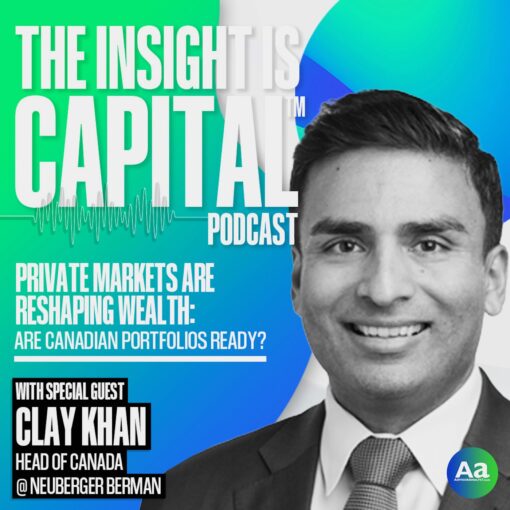
Private Markets Are Reshaping Wealth-Are Canadian Portfolios Ready with Clay Khan

If institutional investors have already shifted toward global diversification and private markets, why are most retail portfolios still stuck in the past?

In this episode of Insight Is Capital, host Pierre Daillie sits down with Clay Khan, Head of Canada and Managing Director at Neuberger Berman, to explore one of the biggest structural changes in modern portfolio construction: the migration of capital from public markets toward private assets and globally diversified strategies.

Drawing from Neuberger Berman’s “Solving for 2026” investment outlook, Khan explains how global macro forces—AI-driven productivity shifts, diverging fiscal and monetary policies, and evolving capital markets—are reshaping the investment landscape for both institutions and private investors.

The conversation dives into the growing dominance of private equity and private credit, why institutional portfolios increasingly resemble pension-style allocations, and why Canadian investors may need to rethink traditional 60/40 portfolio structures.

AI is Splitting the Market – The Hidden Winners Beyond NVIDIA with Ivana Delevska

AI isn’t just about Nvidia anymore — it’s quietly rewiring the entire industrial economy, and most investors don’t even realize where the real money will be made.

In this episode of Raise Your Average, hosts Pierre Daillie and Mike Philbrick sit down with Ivana Delevska, Founder and CIO of Spear Advisors, to unpack how AI is splitting the market — creating massive dispersion between winners and losers — and why passive index exposure may no longer be enough.

While most investors believe they’re diversified through Nasdaq or S&P 500 index funds, Delevska explains that passive exposure is heavily concentrated in mega-cap hyperscalers. The real opportunity, she argues, lies deeper in the AI value chain — in networking, optical components, semiconductor capital equipment, electrification, cybersecurity infrastructure, and even space.

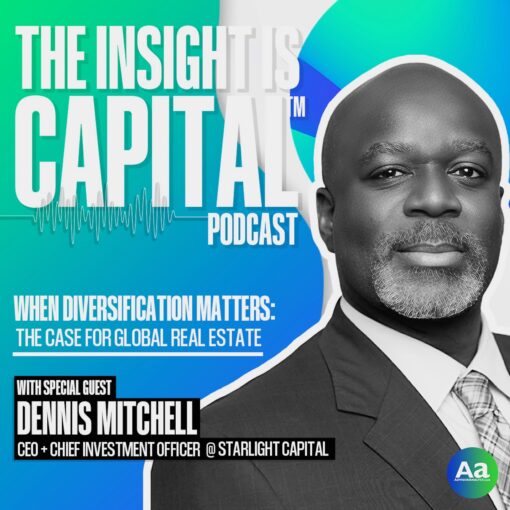
Dennis Mitchell When Diversification Matters – The Case for Global Real Estate

When equity markets grow concentrated and expensive, the real risk isn’t volatility — it’s failing to diversify before the cycle turns.For years, global real estate has sat in what Pierre Daillie calls “the penalty box” — weighed down by rising rates, skepticism, and falling valuations. Yet beneath the headlines, fundamentals never broke.In this episode of Insight Is Capital, Pierre sits down with Dennis Mitchell, CEO and CIO of Starlight Capital, to unpack why global real estate may be one of the most misunderstood — and potentially asymmetric — opportunities in today’s market.

Energy Is Destiny: War, China, Gold, Canada & the 60/40 Era

If energy is destiny and stockpiles signal intent, then this episode may completely change how you see oil, gold, China, Canada—and your portfolio.In this high-conviction macro deep dive, hosts Pierre Daillie and Mike Philbrick sit down with returning guest Doomberg to dismantle the comfortable narratives investors use to understand energy, geopolitics, and portfolio construction.Doomberg reframes the global order through a resource-first lens: energy is destiny, stockpiles signal intent, and technology is rewriting the rules of commodities. From Venezuela and Guyana to China’s war rations, from shale’s molecular revolution to Saskatchewan’s overlooked strategic wealth, this episode challenges the assumptions underpinning the traditional 60/40 portfolio.If the last 50 years were defined by efficiency, globalization, and financialization, the next regime may be defined by resilience, reshoring, and resource leverage.This is not just a discussion about oil. It’s about power.🔑 3 Key Takeaways

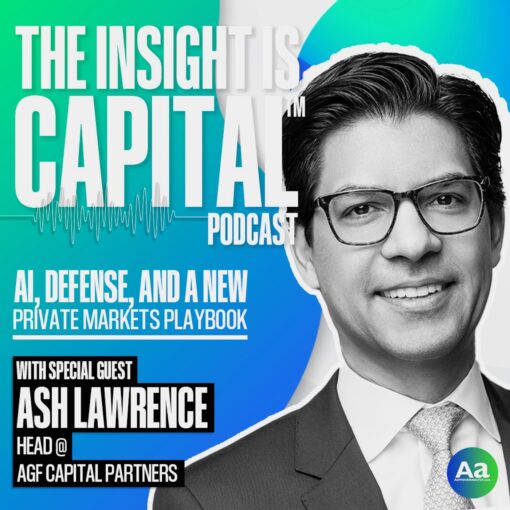
AI, Defense, and a New Private Markets Playbook with Ash Lawrence

Private markets are quietly being rewritten in real time—and in this conversation, Ash Lawrence explains why AI, private credit, and defence could define who wins and who gets left behind in 2026.In this episode of Insight is Capital, host Pierre Daillie sits down with Ash Lawrence, Head of AGF Capital Partners, to unpack AGF Capital Partners’ 2026 – The Annual – Private Markets Outlook.Against a backdrop of geopolitical volatility, AI acceleration, shifting credit dynamics, and renewed defence spending, Lawrence lays out five structural themes reshaping private equity, private credit, and alternative investments.

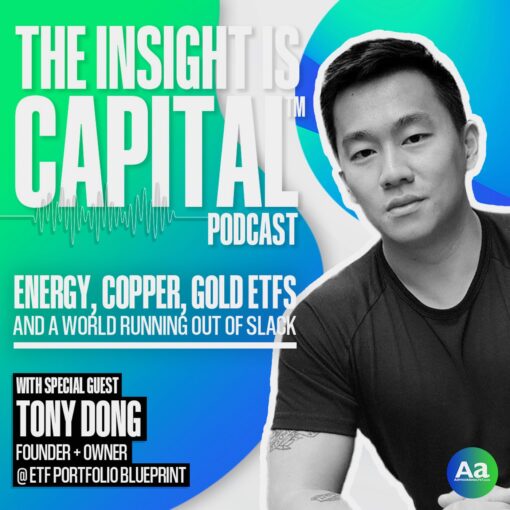
Energy Copper and Gold ETFs and a World Running Out of Slack with Tony Dong

When commodities stop behaving like trades and start behaving like truth detectors, portfolios—and advisors—need to rethink everything.

🎙️ Episode Summary

In this wide-ranging deep-dive, host Pierre Daillie welcomes back Tony Dong, Founder of ETF Portfolio Blueprint, to pressure-test the most common misconceptions about commodities investing.

Rather than treating commodities as volatile, short-term trading instruments, Tony reframes them as strategic portfolio diversifiers—assets whose value lies in low correlation, structural supply constraints, and long-term geopolitical realities.